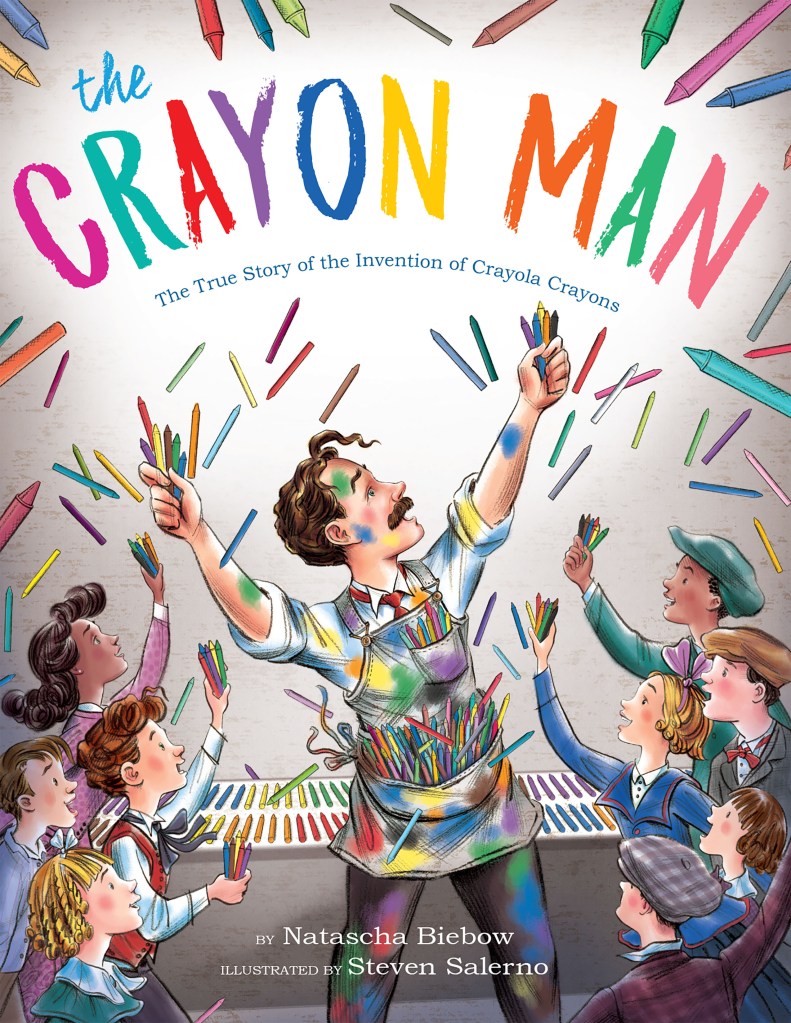
The Crayon Man: The True Story of the Invention of Crayola Crayons (Clarion Books)
Written by Natasha Biebow
Illustrated by Steven Salerno
For ages: 6-9
There’s little chance your students haven’t used crayons as they’ve grown up, and there’s a solid chance they used Crayola brand crayons. This book gives children a history lesson on how those waxy coloring sticks came about. Author Natasha Biebow introduces readers to Edward Binney, a businessman & inventor who ran a company that sold carbon black. Carbon black was a newly developed pigment that could be used in printing inks, polish, and street lamps. Binney created a black wax crayon which became popular to write on paper packages for shipping. Alice, his wife, was a former schoolteacher and said she could see children enjoying multicolored wax crayons to use in their art. Through trial and error, Binney eventually strikes upon a formulation that works. His wife came up with the name “Craie Ola,” meaning “oily chalk.”
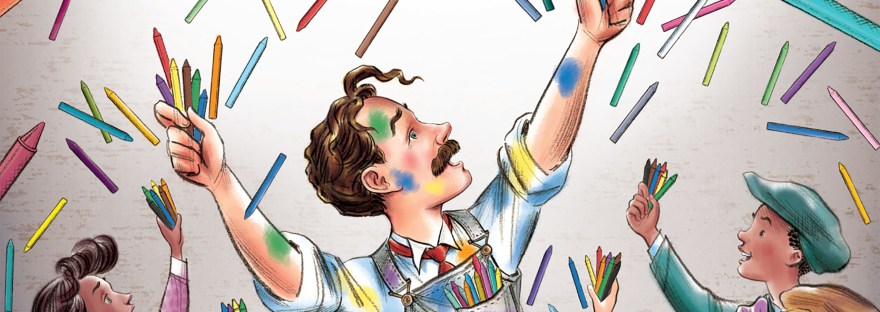
The structure of The Crayon Man is exactly what I was looking for as an elementary school teacher. It has all the facts & information necessary but also uses features like bolding keywords, text boxes with supplemental historical context that can be read after the initial reading to provide more understanding, and illustrations that both express the character’s emotions while being detailed enough to present a world more than a hundred years old to our students. There will be readers who linger on pages like the sooty carbon black factory or the scene as Binney and his workers grind materials to make the rainbow of pigments needed for their crayons. I am a big advocate of children understanding where everyday materials in their lives come from. It helps them understand the labor involved in manufacturing and appreciate objects because many people spend their time developing and producing these things.
Not to toot my own horn, but I have a differentiated close-read packet on this subject over at my TPT store, which would make a great addition to reading this book in the classroom.
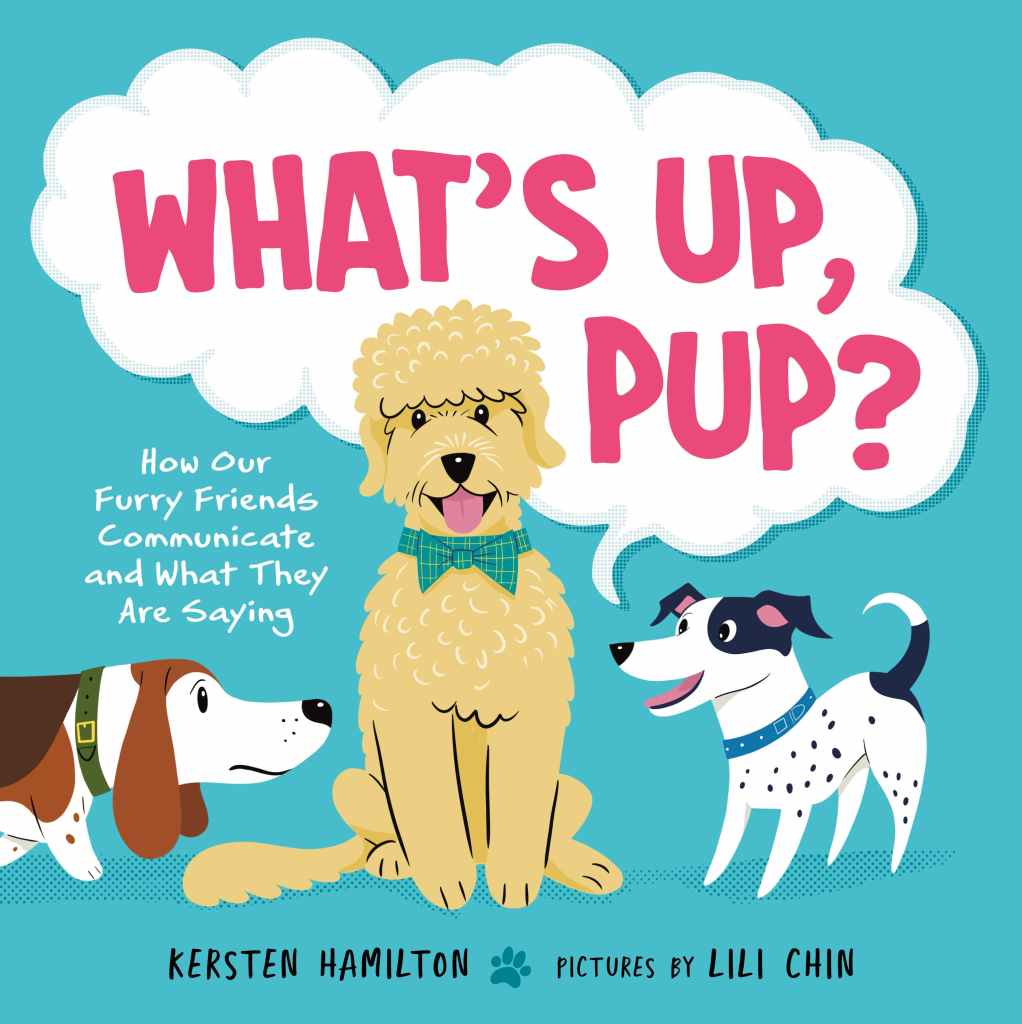
What’s Up Pup: How Our Furry Friends Communicate and What They Are Saying (Farrar, Straus, and Giroux (BYR))
Written by Kersten Hamilton
Illustrated by Lili Chin
For ages: 4-8
When I was a little child, I was so afraid of dogs. I shouldn’t have been, but my parents did not do an excellent job introducing me to dogs and modeling how to act with them. It wasn’t until we got two dogs of our own when I was ten that my confidence with the animals began to grow. It wouldn’t be until I was a full-grown adult and my wife and I got our dogs that I truly began to understand what beautiful, loving creatures they are. The key to this was learning how to read a dog’s body language & barks, their only means of communicating with us humans. These are easy things to misinterpret, and we can’t just use our understanding of people to decode dogs.
What’s Up Pup is an excellent primer for young children to observe a dog to understand its feelings. Through her rhyming text, author Kersten Hamilton lets us know that when you interact with a dog, you should primarily pay attention to its noises and tail. These two indicators will often let you know the animal’s mood and how you should approach them. This is aided by the beautiful illustrations of Lili Chin, who provides a variety of breeds and can perfectly capture the movements of dogs. I particularly love a two-page spread where the sentence “Next, pretty purebreds, mixed, or mutts must wuffle-whiff fur and snuffle-sniff butts” accompanied by over half a dozen dogs in a park sniffing each other’s rear ends. It’s a behavior our students have seen, and the book helps provide context as to why this is happening. A list of behaviors and what they mean to go even deeper with interested readers is included at the end. I recommend this book to alleviate children’s anxieties about interacting with a dog. They will walk away more interested in spending time with a dog and building their confidence with the animals.



 The Reading Circle